
Why RSUs and Stock Options Require Careful Analysis in a Washington Divorce
Equity compensation can represent a significant portion of an employee’s income and overall net worth, particularly among employees in Washington’s technology and life-sciences sectors. However, restricted stock units (“RSUs”) and employee stock options are not always clearly reflected on tax returns, pay statements, or ordinary brokerage statements.
In a Washington divorce, determining the value of an equity award is only part of the analysis. It may also be necessary to determine why the award was granted, what services it was intended to compensate, when each portion vests, and how the relevant periods relate to the parties’ date of separation.
Without this analysis, an equity award may be omitted, valued incorrectly, or classified based on incomplete information.
Why Is an Equity Compensation Analysis Necessary?
RSUs and stock options are different from ordinary shares purchased in a brokerage account. They are generally issued under employer compensation plans and may be subject to:
· Continued-employment requirements;
· Multiple vesting dates;
· Performance conditions;
· Exercise prices and expiration dates;
· Restrictions on transfer or sale;
· Tax withholding upon vesting or exercise;
· Forfeiture provisions; and
· Conversion or modification following a merger, acquisition, or initial public offering.
These provisions affect what the employee owns, when the employee obtains an enforceable right to the award, and what the award may be worth.
A current account statement often provides only a partial picture. It may show the number of outstanding awards without explaining their origin, purpose, vesting requirements, or historical activity.
What Can Be Missed Without a Detailed Review?
Equity-compensation records are often distributed among several sources. The award agreement may describe the original grant, the plan administrator may maintain the vesting history, the brokerage account may show only settled shares, and the pay statement may reflect the taxable income and withholding.
Reviewing only one source may result in incomplete or inconsistent conclusions.
A detailed analysis may identify:
· Awards omitted from the current account statement;
· Shares that vested and were immediately sold for taxes;
· Options that were exercised before the review period;
· Transfers between plan administrators or brokerage accounts;
· Changes resulting from a stock split, merger, or public offering;
· Differences between the original grant and the current vesting schedule;
· Shares transferred or sold after vesting; and
· Equity income reported through payroll but not clearly identified elsewhere.
Reconciling these records can establish a more complete history of the award from grant through vesting, exercise, settlement, transfer, or sale.
Are RSUs and Stock Options Community Property in Washington?
The answer depends on the governing documents and the facts associated with the award.
An award should not necessarily be classified solely according to its grant date or vesting date. Relevant considerations may include whether the employer granted the award to compensate for past or present services, to encourage future employment, or for a combination of purposes.
An award granted during the marriage may include compensation connected to post-separation services. Conversely, an award that vests after separation may still include a component associated with services performed during the marriage.
Washington decisions addressing employee stock options illustrate why the award’s purpose and vesting structure matter. When compensation relates to employment services provided over time, individual vesting installments may require separate consideration.
Legal counsel determines the appropriate characterization under Washington law. A forensic accountant reviews the records, identifying the relevant periods, and calculating the financial effect of the legal framework selected by counsel.
Why Can the Vesting Schedule Change the Analysis?
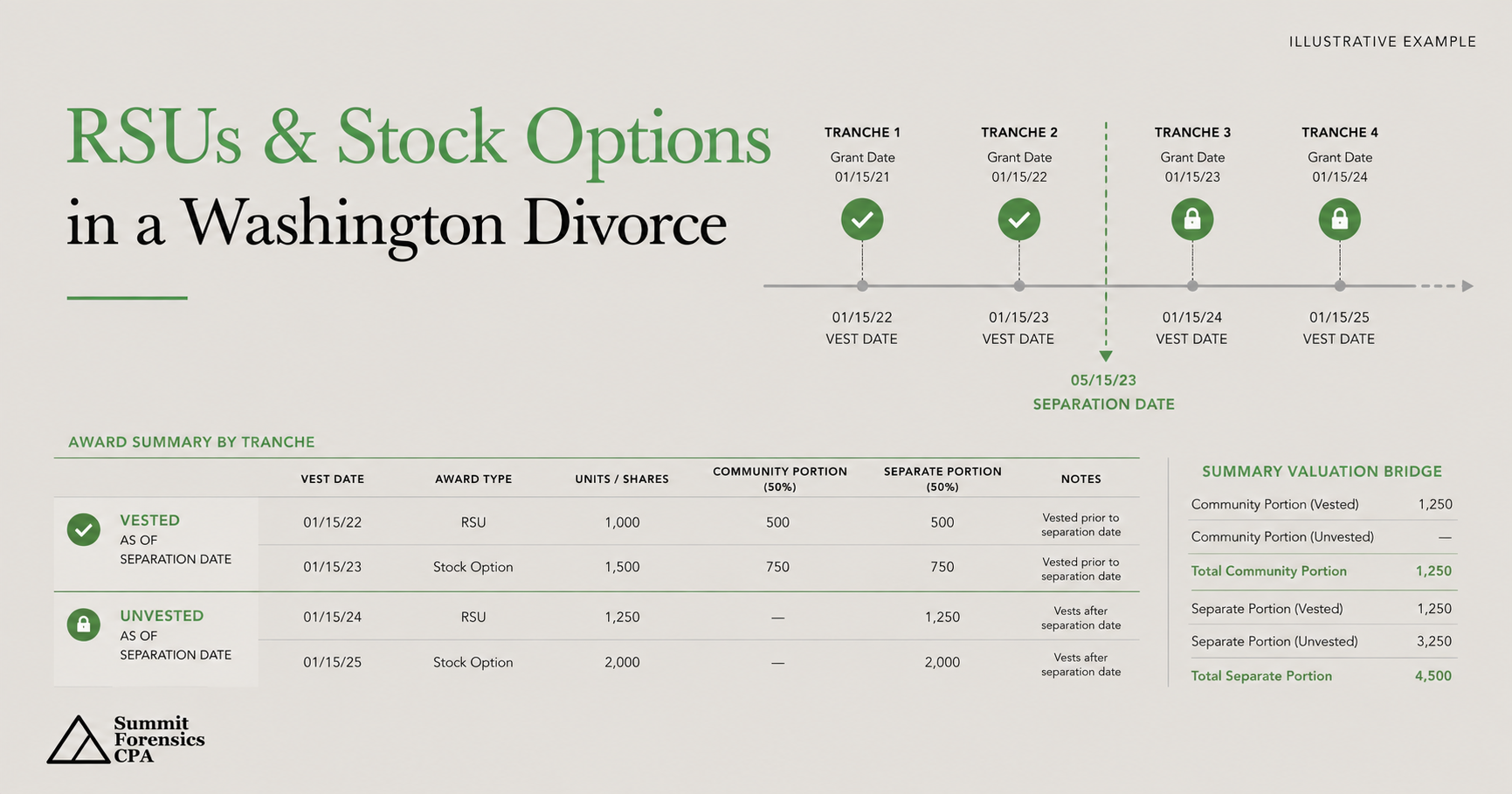
Many equity awards vest in separate installments, commonly referred to as tranches. The employee may receive one grant, but the grant may vest quarterly, annually, or upon the completion of specified employment or performance requirements.
Each tranche can relate to a different period of service. A tranche vesting shortly after separation may reflect both pre-separation and post-separation employment. A tranche vesting substantially later may relate primarily to future services.
For this reason, applying one percentage or conclusion to the entire grant may not accurately reflect the award’s terms.
A tranche-by-tranche review can help identify:
· Which awards were vested or unvested as of the relevant date;
· Which service periods occurred during the marriage;
· Whether later vesting installments require different treatment;
· Whether the employee satisfied the applicable vesting conditions; and
· Whether the original schedule was subsequently modified.
The objective is to present the awards in a manner that reflects the underlying records rather than relying on a single account balance.
Why Isn’t the Current Account Value Enough?
The value displayed by a plan administrator may not be the value relevant to the divorce analysis.
For RSUs, the displayed amount may be based on the company’s current share price even though counsel has selected a different valuation date. It may also include unvested units that remain subject to employment or performance conditions.
For stock options, the number of options multiplied by the current share price can materially overstate value because the employee must generally pay the exercise price to acquire the shares. An option can also have no current intrinsic value while retaining the possibility of future value before expiration.
The appropriate analysis may therefore need to distinguish among:
· Gross market value;
· Exercise cost;
· Intrinsic value;
· Vested and unvested awards;
· Tax withholding;
· Net shares received;
· Sale proceeds; and
· Value as of the date selected by counsel.
Clearly identifying these categories helps prevent values calculated for different purposes from being combined or compared incorrectly.
What Documents Are Commonly Needed?
The documents required will depend on the company and type of compensation. A review commonly includes:
· Equity incentive plans;
· Individual grant notices and award agreements;
· Vesting schedules;
· Plan-administrator and brokerage statements;
· Transaction histories;
· Pay statements reflecting equity income and tax withholding;
· Forms W-2 and other tax records;
· Exercise and sale confirmations;
· Employer compensation summaries; and
· Documents relating to award conversions or modifications.
Obtaining the original award documents is particularly important. A summary screen or current statement may not explain the services compensated by the award or the conditions that apply to each tranche.
When Should an Attorney Consider Retaining a Forensic Accountant?
A forensic accountant may be helpful when:
· Equity compensation represents a material marital asset;
· Multiple grants or vesting schedules are involved;
· Awards remain unvested as of separation;
· The parties disagree about the purpose or characterization of an award;
· The company is privately held or recently became publicly traded;
· Awards were converted or modified;
· Equity transactions must be reconciled to payroll and tax records; or
· Counsel needs a clear schedule for mediation, settlement, or trial.
Early review can also help identify missing records before discovery closes or the matter approaches mediation.
How Can Summit Forensics Help?
Based in Seattle, Summit Forensics assists attorneys and individuals throughout Washington with the analysis of RSUs, stock options, and other equity compensation in Washington divorce matters. Our work may include:
Tracing equity awards and vesting schedules
Analyzing grant, vesting, and separation dates
Reconciling brokerage records, payroll, and tax documents
Quantifying and presenting financial conclusions for mediation, settlement, or trial
If equity compensation is a significant issue in a Washington divorce, early financial analysis can help identify the relevant records, clarify the issues, and focus discovery. Summit Forensics can assist with reviewing the underlying records, reconstructing the award history, and preparing clear financial schedules for counsel, mediation, settlement, or trial.
Contact us to discuss the appropriate scope of analysis for your matter.
This article is provided for general informational purposes only and does not constitute legal advice. The treatment of a specific equity award depends on the governing documents, applicable law, and facts of the matter.
